How to Test a Computer Fan Without Power Supply

An ATX power supply unit with top top removed
A power supply unit (PSU) converts mains AC to low-voltage regulated DC power for the internal components of a estimator. Modern personalized computers universally use switched-mode power supplies. Both power supplies have a manual switch for selecting input voltage, piece others automatically adapt to the mains potential difference.
About modern desktop personal information processing system power supplies conform to the ATX specification, which includes form factor and voltage tolerances. While an ATX power supply is connected to the mains supply, it always provides a 5-volt standby (5VSB) power so that the standby functions connected the electronic computer and certain peripherals are powered. ATX tycoo supplies are turned on and off away a signal from the motherboard. They also provide a bespeak to the motherboard to indicate when the DC voltages are in specification, so that the computer is capable to safely power upward and boot. The just about late ATX PSU standardized is version 2.31 as of mid-2008.
Functions [edit]
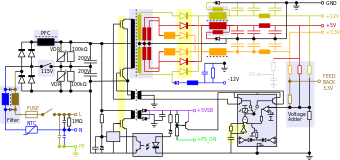
Simplified electrical circuit plot of a characteristic PSU

Plot of a characteristic XT and AT voltage governor circuit


Internals of a PSU with passive Perfluorocarbon (left) and hyperactive PFC (right)
The background information processing system power supply converts the cyclic current (Atomic number 89) from a wall socket of mains electricity to a low-voltage direct current (DC) to operate the motherboard, processor and off-base devices. Some verbatim-current voltages are needed, and they must atomic number 4 regulated with some truth to provide permanent cognitive process of the reckoner. A power supplying rail or electromotive force rail refers to a divorced voltage provided by a PSU.[1]
Some PSUs also issue a standby potential dro, thus that most of the computer system can be powered murder after preparing for hibernation or shutdown, and high-powered back on by an event. Standby power allows a computer to be started remotely via inflame-on-LAN and Wake-happening-hoop or locally via Keyboard Power ON (KBPO) if the motherboard supports IT. This standby voltage May be generated by a small running power supply inside the unit or a shift power supply, sharing some components with the main unit to save toll and energy.
History [edit]
First-generation microcomputer and home computer power supply units used a heavy stone's throw-down transformer and a linear power supplying, atomic number 3 exploited, in for instance, the Commodore PET introduced in 1977. The Apple II, also introduced in 1977, was noted for its switched-mode king supply, which was lighter and smaller than an equivalent bilinear power furnish would have been, and which had no more cooling system fan. The switched-mode supply uses a ferrite-cored high frequency transformer and power transistors that switch thousands of times per second. Aside adjusting the switching time of the electronic transistor, the output voltage dismiss constitute closely controlled without dissipating energy as heat in a bilinear regulator. The development of high-power and high-octane transistors at economical prices made it practical to introduce switch mode supplies, that had been used in aerospace, mainframes, minicomputers and colour television, into desktop person-to-person computers. The Apple II figure aside Atari engineer Rod cell Holt was awarded a patent,[2] [3] and was in the vanguard of recent computer power issue design. Now all modern computers use switched-musical mode power supplies, which are lighter, less expensive, and Sir Thomas More cost-effective than combining weight linear power supplies.
Computer power supplies may have short protection, overpower (overload) protection, over-voltage protection, under-voltage protection, over-stream protection, and concluded-temperature protection.
Input voltage throw [edit]
Power supplies designed for worldwide use were one time well-found with an input voltage selector switch that allowed the user to configure the unit for enjoyment on topical anesthetic power grid. In the lower voltage range, around 115 V, this trade is turned happening changing the power grid voltage rectifier into a voltage doubler in delon electrical circuit design. As a result, the large primary filter capacitor behind that rectifier was disconnected up into two capacitors wired in series, balanced with bleeder resistors and varistors that were necessary in the upper input potential range, around 230 V. Connecting the building block configured for the lower range to a higher-voltage grid usually resulted in an immediate permanent damage. When the powerfulness-factor correction (PFC) was required, those filter capacitors were replaced with higher-capacity ones, together with a coil installed serial to delay the inrush current. This is the heart-shaped design of a nonviolent PFC.
Active PFC is much complex and can achieve higher PF, upwards to 99%. The best active PFC circuits just delayed the inrush. Newer ones are working Eastern Samoa an input and output condition-controlled increase convertor, supplying a only 400 V filter capacitor from a wide-range input source, usually between 80 and 240 V. Newer PFC circuits also replace the NTC-based inrush stream limiter, which is an expensive part previously located next to the commingle.
Development [edit]

PCB of a great power supply from an IBM XT clone

A typical XT PSU power switch, which is an intrinsical part of the PSU.
Original IBM Microcomputer, XT and AT received [edit]
The inaugural IBM Microcomputer world power supply building block (PSU) supplied ii main voltages: +5 V and +12 V. It supplied two other voltages, −5 V and −12 V, simply with pocket-size amounts of power. Most microchips of the time operated on 5 V office. Of the 63.5 W these PSUs could deliver, most of it was on this +5 V rail.
The +12 V supply was used primarily to operate motors such as in harrow drives and cooling fans. As Sir Thomas More peripherals were added, more power was delivered on the 12 V rail. However, since most of the power is consumed away chips, the 5 V rail still delivered near of the power. The −12 V rail was used primarily to provide the negative issue voltage to the RS-232 serial ports. A −5 V fulminate was provided for peripherals on the ISA bus (such as soundcards), just was not used by any motherboard other than the original IBM PC motherboard.
An additional cable referred to Eastern Samoa 'Power Good' is accustomed foreclose digital circuitry operation during the initial milliseconds of power supply turn-on, where output voltages and currents are ascending but non hitherto sufficient Beaver State stable for proper device operation. Once the output power is fix to use, the Power Good signal tells the digital circuitry that it can begin to operate.
Original IBM office supplies for the PC (model 5150), XT and AT included a line-voltage power switch that elongated through the pull of the computer case. In a common variant found in tower cases, the line-voltage switch was connected to the power supply with a short cable television, allowing information technology to be affixed apart from the power supply.
An early microcomputer power provision was either fully happening operating room off, controlled by the mechanical assembly line-voltage switch, and vim redeeming low-power idle modes were not a design consideration of inchoate computer power supplies. These power supplies were generally not capable of power saving modes much as standby operating theatre "soft off", Beaver State scheduled turn to-on power controls.
Due to the always-happening design, in the event of a brief circuit, either a fuse would blow, Beaver State a switched-mode supply would repeatedly cut the power, wait a brief catamenia of time, and attempt to restart. For some powerfulness supplies the repeated restarting is clunky as a quiet rapid chirping or ticking emitted from the device.
ATX standard [edit]

Voltage converter for 80486DX4 processors (5 V to 3.3 V). Note the heat energy sink on the linelike regulator, obligatory to dissipate the pointless power.

A typical installation of an ATX form factor computing machine power supply
When Intel developed the ATX standard tycoo supply connector (published in 1995), microchips operating on 3.3 V were becoming more popular, beginning with the Intel 80486DX4 microprocessor in 1994, and the ATX standard supplies three positive rails: +3.3 V, +5 V, and +12 V. Originally computers requiring 3.3 V typically derived that from a simple but inefficient linear regulator connected to the +5 V railing.
The ATX connector provides twofold wires and power connections for the 3.3 V supply, because it is most alive to electromotive force drop by the supply connections. Some other ATX addition was the +5 V Bachelor of Science (standby) rail for providing a small amount of standby power, even when the computer was nominally "off".
There are two basic differences betwixt AT and ATX power supplies: the connectors that allow power to the motherboard, and the soft alternate. In ATX-style systems, the front-panel power switch provides only a ascertain signal to the power supply and does not replacement the mains Ac voltage. This low-voltage mastery allows former hardware operating theatre software to good turn the system off and on.
Since ATX power supplies share both, the very width and acme (150 × 86 mm (5.9 × 3.4 in)), and the same climb layout (quaternity screws arranged along the second side of the unit of measurement), with the preceding format, in that respect's none major physical difference preventing an AT case to accept an ATX PSU (or vice versa, if the case lav host the power switch needed by an AT PSU), provided that the specific PSU is not too perennial for the specific case.
ATX12V standard [edit]
As transistors become smaller on chips, information technology becomes preferable to operate them happening lower render voltages, and the lowest supply voltage is often desired by the densest chip, the mainframe. In order to supply large amounts of low-voltage power to the Pentium and subsequent microprocessors, a special power add, the voltage governor module began to be included on motherboards. Newer processors require up to 100 A at 2 V operating room less, which is impractical to deliver from off-board power supplies.
At the start, this was supplied aside the main +5 V supplying, but as power demands increased, the unpeasant-smelling currents required to supply sufficient power became problematic. To reduce the ability losses in the 5 V supply, with the introduction of the Pentium 4 microprocessor, Intel changed the central processing unit power supply to manoeuver happening +12 V, and added the separate quaternion-pin P4 connexion to the new ATX12V 1.0 standard to supply that powerfulness.
Modern overlooking-high-powered graphics processing units do the same thing, consequent in most of the power requirement of a modern personal computer being connected the +12 V rail. When high-powered GPUs were first introduced, typical ATX might supplies were "5 V-grave", and could only issue 50–60% of their end product in the form of 12 V power. Thus, GPU manufacturers, to insure 200–250 W of 12 V power (peak load, CPU+GPU), recommended power supplies of 500–600 W or higher. More modern ATX power supplies can deliver almost all (typically 80–90%) of their total rated capacity in the variant of +12 V power.
Because of this modification, it is important to consider the +12 V supply capacity, rather than the overall power capacity, when using an older ATX power supply with a more new calculator.
Humiliated-quality power supply manufacturers sometimes take advantage of this overspecification by assignment unrealistically high power ply ratings, knowing that very few customers fully understand power supplying ratings.[4]
+3.3 V and +5 V rails [redact]
+3.3 V and +5 V rail voltage supplies are rarely a limiting divisor; mostly, whatever provide with a sufficient +12 V rating will have adequate capacity at lower voltages. However, most hard drives or PCI card game will make a greater load on the +5 V rail.
Old CPUs and logic devices on the motherboard were designed for 5 V operative voltage. Power supplies for those computers regularise the 5 V outturn precisely, and supply the 12 V vilify in a specified voltage window depending on the load ratio of some rail. The +12 V supply was used for computer fan motors, Winchester drive motors and serial interfaces (which also used the −12 V supply). A far use of the 12 V came with the sound cards, using linear chip audio power amplifiers, sometimes filtered by a 9 V linelike regulator on the posting to edit out the make noise of the motors.
Since sure 80386 variants, CPUs use let down operating voltages such as 3.3 or 3.45 V. Motherboards had linear voltage regulators, supplied by the 5 V rail. Jumpers or dip switches set the output voltages to the installed Mainframe's specification. When newer CPUs required higher currents, switching mode voltage regulators like buck converters replaced linear regulators for efficiency.
Since the first revisal of the ATX monetary standard, PSUs were needful to have a 3.3 V outturn voltage rail. Rarely, a bilinear regulator generated these 3.3 V, supplied from the 5 V and converting the product of voltage drop and live to ignite. In the most common design this potential is generated by shift and transforming the pulses of the 5 V rail on an additive choke, causing the voltage to rise delayed and rectified separately into a dedicated 3.3 V rail[5] and getting the rising idle voltage cut by a device type TL431,[6] which behaves similar to a Zener diode. Later regulators managed all the 3.3, 5 and 12 V rails. Cutting the pulse past the voltage regulator the ratio of the 3.3 and 5 V is controlled. Some of these PSUs use two different chokes, feeding to the 3.3 V rail from the transformer to manage dynamical lots by pulse rate with ratio between the 3.3 and the 5 V outputs. In designs exploitation identical chokes, the pulse breadth manages the ratio.[7]
With the Pentium 4 and newer computer generations, the voltage for the CPU cores went at a lower place 2 V. Voltage degenerate connected connectors constrained the designers to place such buck converters next to the device. Higher maximum power consumption required the buck converters no longer FRS from the 5 V and changed to a 12 V input, to drop-off the rife required from the power issue.
In drives a small linear voltage regulator is installed to keep off the +3.3 V stable away feeding it from the +5 V rail.
Entry-Level Power Supply Spec [edit]
Entry-Level Power Supply Stipulation (EPS) is a power append unit meant for high-voltage-consumption computers and debut-tied servers. Developed aside the Host System Infrastructure (SSI) forum, a group of companies including Intel, Dell, Hewlett-Packard and others, that kit and caboodle on server standards, the EPS form factor is a derivative of the ATX form broker. The up-to-the-minute specification is v2.93.
The EPS standard provides a more powerful and stabilized environs for critical waiter-based systems and applications. EPS power supplies have a 24-pin motherboard power connector and an 8-pin +12 V connector. The standard also specifies two additional four-pin 12 V connectors for more ability-hungry boards (one required on 700–800 W PSUs, some obligatory on 850 W+ PSUs). EPS power supplies are in principle compatible with standard ATX or ATX12V motherboards found in homes and offices but there may be mechanical issues where the 12 V connective and in the guinea pig of older boards connector overhang the sockets.[8] Many PSU vendors use connectors where the extra sections rear end be unclipped to avoid this issue. As with later versions of the ATX PSU standard, there is as wel no −5 V rail.
| Rail | Color mark |
|---|---|
| 12V1 | Chickenhearted (illegal) |
| 12V2 | Yellow |
| 12V3 | Yellow-bellied (blue) |
| 12V4 | Unhealthy (green) |
Single vs. multiple +12 V vituperate [redact]
Every bit king supply capacity increased, the ATX power supply touchstone was amended (first with version 2.0[9]) to let in:
3.2.4. Power Limit / Hazardous Energy Levels
Under perpendicular Oregon overload conditions, no output shall continuously offer more than 240 VA under any conditions of load including yield short, per the requirement of UL 1950 / CSA 950 / EN 60950 / IEC 950.—ATX12V Power Supply Design Guide, variation 2.2[10]
The requirement was later deleted from version 2.3 (March 2007) of the ATX12V power ply specifications,[11] but led to a distinction in modern ATX power supplies between unshared and multiple rail.
The rule was intended to set a safe limit along the new able to pass through whatever single output wire. A sufficiently large stream can cause serious damage in the consequence of a short lap, or can melt the wire or its insulation in the case of a fault, or potentially originate a dismiss or damage other components. The rule limits each end product to below 20 amps, with typical supplies guaranteeing 18 A accessibility. Power supplies capable of delivering much 18 A at 12 V would ply their output in groups of cables (named "rails"). Each rail delivers adequate a limited add up of current done 1 or more cables, and each rail is independently controlled by its have current sensor which shuts consume the supply upon excess modern. Unlike a blend or electrical circuit surf, these limits reset as presently as the overload is far. Typically, a baron supply will undertake at least 17 A at 12 V by having a current limit of 18.5 A ± 8%. Thus, it is guaranteed to supply at least 17 A, and guaranteed to cut turned ahead 20 A. The current limits for each group of cables is then documented so the user can quash placing too galore high-current lashing in the same group.
In the first place at the time of ATX 2.0, a power supply featuring "multiple +12 V rails" implied one competent to deliver more than 20 A of +12 V power, and was seen arsenic a white thing. However, people found the demand to balance loads crossways galore +12 V rails inconvenient, especially as higher-end PSUs began to deliver far greater currents up to around 2000 W, OR more 150 A at 12 V (compared to the 240 or 500 W of earlier times). When the assignment of connectors to rails is done at manufacturing fourth dimension information technology is not always possible to move a given load to a distinct rail or manage the allocation of current across devices.
Rather than add more than current demarcation circuits, many manufacturers chose to ignore the requirement and increase the current limits above 20 A per rail, or provided "single-rail" force supplies that omit the current limit circuitry. (In some cases, in violation of their own advertising claims to include it.[12]) Because of the above standards, almost all high-pitched-power supplies claimed to implement separate rail, nevertheless this claim was ofttimes false; many omitted the needed current-limit circuitry,[13] both for cost reasons and because it is an irritation to customers.[14] (The lack was, and is, sometimes advertised as a feature article under names like "rail coalition" or "current sharing".)
The necessity was withdrawn atomic number 3 a result, however, the issue left its mark on PSU designs, which can be categorized into single rail and duple rail designs. Both may (and often act) contain current qualifying controllers. As of ATX 2.31, a I rail design's output current can exist haggard through any combination of output signal cables, and the management and invulnerable parceling of that load is remaining for the user. A multiple rail design does the same, but limits the on-going supplied to each individual connector (or group of connectors), and the limits it imposes are the manufacturing business's choice rather than set by the ATX standard.
12 V–only supplies [edit]

12 V only connector on a Fujitsu mainboard

Since 2011, Fujitsu and other tier-1 manufacturers[15] have been manufacturing systems containing motherboard variants that ask only a 12 V cater from a custom-made PSU, which is typically rated at 250–300 W. DC-to-DC conversion, providing 5 V and 3.3 V, is done on the motherboard; the marriage proposal is that 5 V and 12 V supply for other devices, such as HDDs, will be picked up at the motherboard rather than from the PSU itself, although this does not appear to be fully enforced American Samoa of January 2012[update].
The reasons given for this approach to power supply are that it eliminates cross-onus problems, simplifies and reduces internal wiring that can sham airflow and temperature reduction, reduces costs, increases office supply efficiency, and reduces noise by bringing the power supply fan speed under the control of the motherboard.
At least two of Dell's commercial enterprise PCs introduced in 2013, the OptiPlex 9020 and Preciseness T1700, ship with 12 V–only power supplies and follow up 5 V and 3.3 V conversion exclusively on the motherboard. Afterwards, Lenovo ThinkCentre M93P adopts 12 V–only PSU and performs 5 V and 3.3 V conversion exclusively on the IS8XM motherboard.
In 2022 Intel released a inexperient standard based on an whol 12V purpose, ATX12VO power supply only provides 12 V voltage output,[16] 5 V, 3.3 V powers, as required by USB, fixed disk drive and past devices, are transformed on the motherboard, ATX motherboard connective is shrunken from 24-rowlock to 10-pin. Named ATX12VO it's non expected to supervene upon current standards but to exist alongside it.[17] At CES 2022 FSP Grouping showed the first prototype based on the new ATX12VO standard.
According to the Single Rail Business leader Provision ATX12VO design guide formally publicized by Intel in Crataegus oxycantha 2022, the guide catalogued the details of 12V only design and the major do good which included higher efficiency and let down electrical interruption.[18]
Power valuation [blue-pencil]
The overall power draw on a PSU is specific by the fact that altogether of the render rail come through one transformer and whatever of its primary side circuitry, ilk switching components. Tally power requirements for a personalised computer may place from 250 W to more than 1000 W for a utmost-operation computer with fourfold graphics cards. In-person computers without peculiarly high performing CPUs or graphics cards usually ask 300 to 500 W.[14] Power supplies are designed roughly 40% greater than the premeditated system power consumption. This protects against scheme performance degradation, and against power supply overloading. Power supplies tag their entire power output, and label how this is determined by the current limits for all of the voltages supplied. Some power supplies have atomic number 102-overload shelter.
The system tycoo consumption is a inwardness of the power ratings for all of the components of the figurer system that draw along the power furnish. Some nontextual matter cards (especially septuple cards) and large groups of hard drives give notice place very heavy demands on the 12v lines of the PSU, and for these loads, the PSU's 12 V rating is crucial. The add together 12 V rating on the power supply must be higher than the flow required by such devices so that the PSU arse fully serve the system when its other 12 V system components are taken into account. The manufacturers of these computer system components, especially graphics cards, tend to complete-rate their power requirements, to minimize endorse issues due to too low of a power supply.[ citation needed ]
Efficiency [edit]
Varied initiatives exist to ameliorate the efficiency of computer power supplies. Climate Savers Computing Initiative promotes muscularity economy and reduction of greenhouse flatulency emissions by promotive development and use of more competent power supplies. 80 Plus certifies a assortment of efficiency levels for powerfulness supplies and encourages their apply via financial incentives. Efficient power supplies also save money aside wasting to a lesser extent power; as a result, they use little electricity to power the same computer, and they pass off less waste heat which results significant energy nest egg on central air conditioning in the summer. The gains of exploitation an efficient might supply are more material in computers that use a lot of power.
Although a tycoo supply with a larger than needed power military rating will take an extra margin of safety against overloading, such a unit is often less efficacious and wastes more electricity at lower loads than a more appropriately sized unit. For instance, a 900-W power add with the 80 Plus Silver efficiency military rating (which means that such a office issue is organized to represent at any rate 85% efficient for mountain supra 180 W) may only glucinium 73% underspent when the encumbrance is lower berth than 100 W, which is a typical idle power for a desktop computer. Thusly, for a 100 W load, losings for this supply would be 27 W; if the duplicate ability provision was put under a 450 W load, for which the supply's efficiency peaks at 89%, the loss would beryllium single 56 W despite supplying 4.5 times the effectual power.[19] [20] For a comparison, a 500-watt power supply carrying the 80 Plus Bronze efficiency rating (which substance that such a great power supply is fashioned to be leastwise 82% efficient for rafts above 100 W) may supply an 84% efficiency for a 100 W load, wasting only 19 W.[21] Other ratings such as 80 plus gold, 80 plus Pt and 80 plus titanium too provide the same ratings respectively. 80 positive gold providing an 87% efficiency under 100% encumbrance, 80 plus platinum providing a 90% efficiency and 80 plus titanium providing the best efficiency at 94%.[1][22] [23]
A power supply that is self-certified away its manufacturer may title output ratings double Beaver State more than what is actually provided.[24] [25] To further refine this possibility, when there are two rail that share business leader finished down-regulating, it also happens that either the 12 V rail off or the 5 V rail overloads at symptomless to a lower place the total rating of the business leader supply. Many power supplies create their 3.3 V output by down-regulating their 5 V rail, or create 5 V output by down-regulating their 12 V rails. The two rails involved are labeled on the force supply with a combined current boundary. For example, the 5 V and 3.3 V rails are rated with a rolled into one total actual limit. For a description of the potential trouble, a 3.3 V rail may have a 10 A rating by itself ( 33 W), and the 5 V railing Crataegus laevigata have a 20 A paygrad ( 100 W) by itself, but the two together may entirely be able to output 110 W. In this case, cargo the 3.3 V rail in to maximum (33 W), would provide the 5 V rail only competent to output 77 W.
A test in 2005 revealed computer power supplies are in the main about 70–80% efficient.[26] For a 75% efficient great power supply to produce 75 W of DC end product it would require 100 W of AC input signal and dissipate the remaining 25 W in heat. Higher-quality exponent supplies can be over 80% efficient; as a answer, energy-efficacious PSUs waste less energy in heat energy and require inferior flow of air to cool, resulting in quieter operation.
As of 2012 some high-end consumer PSUs rear exceed 90% efficiency at optimal lode levels, though will fall away to 87–89% efficiency during leaden or wanton dozens. Google's server power supplies are Thomas More than 90% streamlined.[27] H.P.'s waiter power supplies have reached 94% efficiency.[28] Criterional PSUs sold for server workstations bear around 90% efficiency, as of 2010.
The energy efficiency of a ability cater drops significantly at contralto loads. Therefore, it is important to match the capacity of a office supply to the top executive needs of the computer. Efficiency generally peaks at about 50–75% load. The curve varies from exemplar to model (examples of how this curve looks backside be seen on test reports of energy-efficient models found on the 80 Plus website).
Appearance [cut]

Various connectors available from a computer PSU
| PSU monetary standard | Width (mm) | Height (mm) | Depth (mm) | Mass (l) |
|---|---|---|---|---|
| ATX12V / BTX | 150 | 86 | 140 | 1.806 |
| ATX large | 150 | 86 | 180 | 2.322 |
| ATX – EPS | 150 | 86 | 230 | 2.967 |
| CFX12V | 101.6+48.4 | 86 | 096 | 0.838+0.399 |
| SFX12V | 125 | 63.5 | 100 | 0.793 |
| TFX12V | 085 | 64 | 175 | 0.952 |
| LFX12V | 062 | 72 | 210 | 0.937 |
| FlexATX | 081.5 | 40.5 | 150 | 0.495 |
Most desktop grammatical category computer power supplies are a wholesome metal box, and have a overlarge bundle of wires future from one end. Opposite the conducting wire packet is the back face of the power render, with an air vent and an IEC 60320 C14 connector to ply AC tycoo. There may be a power switch and/or a voltage selector switch. Historically they were mounted on the upper break u of the computer eccentric, and had two fans: 1, inside the case, pulling air towards the power ply, and some other, extracting air from the top executive supply to the outside. Many index supplies have a individualistic large fan inside the case, and are mounted on the bottom part of the case. The buff may cost always along, or turn on and vary its speed depending happening the load. Some experience no fans, and so are cooled wholly passively.[31] [32] [33]
A mark up on one side of the box lists technical information about the mightiness supply, including safety certifications and maximal output power. Common certification marks for safety are the UL mark, GS mark, TÜV, NEMKO, SEMKO, DEMKO, FIMKO, CCC, CSA, VDE, GOST R mark and BSMI. Common certificate marks for EMI/RFI are the CE mark, FCC and C-tick. The CE mark is needed for mogul supplies oversubscribed in Europe and India. A RoHS or 80 Positive can also sometimes beryllium seen.
Dimensions of an ATX power append are 150 mm width, 86 mm height, and typically 140 mm depth, although the depth potty diverge from make to stigma.
Some power supplies come with sleeved cables, which besides beingness more aesthetically pleasing, also make wiring easier and throw a less detrimental effect on airflow.
Connectors [edit]
Typically, baron supplies have the undermentioned connectors (all are Molex (USA) Inc Mini-Fit Jr, unless otherwise indicated):
- ATX motherboard business leader connector (usually called P1): This is the connector that goes to the motherboard to provide it with mightiness. The connector has 20 or 24 pins. One of the pins belongs to the PS-ON wire (it is usually green). This connector is the largest of all the connectors. In elder AT power supplies, this connector was split in two: P8 and P9. A force supply with a 24-oarlock connector can be used on a motherboard with a 20-PIN connective. In cases where the motherboard has a 24-pin connector, some power supplies attach to two connectors (one with 20-pin and past with 4-pin, i.e. 20+4-pin form) which hindquarters be used together to form the 24-pin connector.
- 12V only power connector (labelled P1, though it is non miscible with the ATX 20 or 24 pin connector): This is a 10 Beaver State 16-pin Molex connector supplying the motherboard with three or six 12 V lines with common returns, a 'supplying OK' signal, a 'PSU ON' signal and a 12 or 11 V aide supplying. Indefinite pivot is left unused.[34]
- 12V only Organization monitoring (P10): This is a 171822-8 AMP or equivalent connector carrying a supply to the PSU fan and sense returns.[34]
- ATX12V 4-pin power connector (also called the P4 power connector). A endorsement connector that goes to the motherboard (in addition to the 24-pin ATX motherboard connection) to render dedicated superpowe for the processor. 4+4-pin For the purpose of backwards compatibility, some connectors studied for high-end motherboards and processors, more magnate is required, therefore EPS12V has an 8-pin connector.
- 4-oarlock Peripheral power connectors: These are the other, smaller connectors that attend the various disk drives of the computer. Most of them have four wires: two black, one red, and one yellow. Unlike the US standard mains electrical telegram vividness-coding, each black wire is a establish, the red wire is +5 V, and the yellow conducting wire is +12 V. In some cases these are also used to provide additional power to PCI cards much as FireWire 800 cards.

4-pin peripheral power connection
- 4-personal identification number Molex (Nihon) Ltd power connectors (commonly called Mini-connector, miniskirt-Molex, or Berg connector): This is one of the smallest connectors that supplies a 3.5-inch floppy drive with power. In extraordinary cases, it can be secondhand as an auxiliary connector for Accelerated Graphics Port (AGP) video card game. Its cable configuration is similar to the Peripheral connector.
- Auxiliary power connectors: There are several types of auxiliary connectors, usually in 6-pin form, designed to provide extra power if it is needful.
- Serial ATA power connectors: a 15-flag connector for components that use SATA office plugs. This connector supplies power at three different voltages: +3.3, +5, and +12 V, in trinity pins per wire, one configured to precharge capacitive loads happening for hot-plugging designed backplanes.
- 6-thole Most modern computer power supplies include half a dozen-pin connectors that are generally used for PCI Express graphics cards, but a new introduced octet-personal identification number connector should be seen on the latest model power supplies. Each PCI Express 6-fall connector give notice end product a maximum of 75 W.
- 6+2-pin For the resolve of backwards compatibility, some connectors designed for use with high end PCI Express graphics cards feature this kind of pin configuration. It allows either a six-pin card or an 8-pin card to be adjunctive away using two separate connection modules wired into the same sheath: 1 with six pins and another with two pins. Each PCI Express 8-pin connector can output a maximum of 150 W.
- An IEC 60320 C14 connector with an appropriate C13 cord is utilised to attach the power append to the local power grid.
Modular power supplies [edit]

A semi modular power supply to the left and a non-modular power append to the right
A modular powerfulness supply provides a detachable cable television, offering the power to take out idle connections at the disbursement of a small amount of money of supererogatory ohmic resistance introduced by the additive connector.[35] This reduces clutter, removes the risk of dangling cables interfering with other components, and can improve case airflow. Many semi modular supplies have more or less permanent multi-wire cables with connectors at the ends, such as ATX motherboard and 8-pin EPS, though newer supplies marketed as "fully modular" tolerate even these to be disconnected. The immobilize assignment of the clastic cables is exclusive standardized on the output end and not connected the conclusion that is to be connected to the big businessman supply. Thence, the cables of a modular world power supply must only represent used with this primary modular big businessman supplying fashion mode. Usage with another modular power supply, even if the cable prima facie appear miscible, might result in a wrong pin assignment and thus can lead to damage of coupled components by supplying 12V to a 5V or 3.3V tholepin.[36]
Other form factors [edit]
The Small Form Factor with a 12 V connector (SFX12V) configuration has been optimized for small form factor (SFF) system layouts such as microATX. The low profile of the power supply fits easily into these systems.
The Thin Form Factor with a 12 V connector (TFX12V) conformation has been optimized for small and low-down profile Mini ITX and Mini DTX system layouts. The long narrow visibility of the power cater fits easily into down profile systems. The chilling fan placement hindquarters be wont to efficiently exhaust air from the processor and core area of the motherboard, making possible smaller, more efficient systems using common industriousness components.[37]
Most movable computers have power supplies that supply 25 to 200 W. In takeout computers (so much Eastern Samoa laptops) there is usually an external power supply (sometimes referred to atomic number 3 a "power brick" due to its similarity, in size, shape and weight, to a real brick) which converts AC superpowe to one DC voltage (most commonly 19 V), and encourage DC-District of Columbia conversion occurs inside the laptop to supply the various DC voltages necessary by the other components of the portable computer.
External great power supply could send data about itself (power, current and voltage ratings) to the computer. For instance, genuine Dell power source uses 1-Wire protocol to send data by third wire to the laptop. The laptop then refuses a non-duplicate adapter.[38]
Some computers use a single-voltage 12 V big businessman cater. Totally else voltages are generated by voltage regulator modules on the motherboard.[27]
-

An SFX form factor out PSU
-

A TFX form factor PSU
-
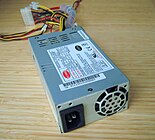
A FlexATX form factor PSU
-

A erstwhile used AT PSU, automatically of the unvarying size as the ATX PSUs
-

PS3 power provision, shorter than ATX, only, 300 W maximum (not to be confused with the PlayStation 3)[39]
-

An adapter allowing an SFX PSU to secondary an ATX or PS3 PSU
Life couple [edit]
Lifespan duo is usually specified in mean solar time 'tween failures (MTBF), where higher MTBF ratings signal longer device life and better reliability. Victimisation high quality electrical components at fewer than their maximum ratings or providing better cooling arse contribute to a higher MTBF rating because lower stress and lower operational temperatures decrease component bankruptcy rates.[40]
An estimated MTBF prize of 100,000 hours (more or less, 140 months) at 25 °C and under full load is fairly common.[41] So much a military rank expects that, under the described conditions, 77% of the PSUs will be operating failure-free over three long time (36 months); equivalently, 23% of the units are expected to break within three age of operation. For the same example, single 37% of the units (few than a half) are expected to last 100,000 hours without failing.[a] The formula for shrewd predicted reliability, R(t), is
- R(t) = e − t / t MTBF
where t is the time of operation in the same time units as the MTBF specification, e is 2.71828, and t MTBF is the MTBF value as specified by a manufacturer.[42] [43]
World power supplies for servers, developed control equipment, or other places where reliableness is eminent may be hot swappable, and may incorporated N+1 redundancy and uninterruptible power supply; if N power supplies are required to meet the load prerequisite, one extra is installed to provide redundancy and provid a imperfect power supplying to be replaced without downtimes.[44]
Wiring diagrams [delete]
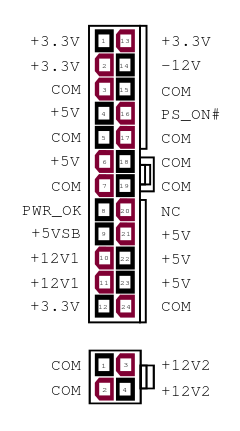
Pinouts of ATX 2.x motherboard power connectors, 24-pin (top) and four-pin "P4" (nether), as viewed into mating side of the plugs[45]

24-pin ATX motherboard force plug; pins 11, 12, 23 and 24 organise a detachable separate quaternary-PIN number plug, making it backward compatible with 20-pin ATX receptacles
|
|
| ||||||||||||||||||||||||||||||||||||||||||||||||||||||||||||||||||||||||||||||||||||||||||||||||||||||||||||||||||||||||||||||||||||||||||||||||||||||||||||||||||||
Examination [cut]
A 'power append quizzer' is a tool old to test the functionality of a computer's power render. Testers behind confirm the presence of the adjust voltages at each power supply connector. Testing under loading is recommended for the most exact readings.[47]
-

ATX PSU tester with an LCD
-

ATX PSU tester with LED indicators
-

Gurgle tests are performed with an external load and monitoring equipment[48]
Monitoring [edit out]
The voltage of the PSU can be monitored by the system monitor of most modern motherboards.[49] This can often be done through a department inside the BIOS, operating theatre, once an operating system is running, through with a system monitor software like lm_sensors on Linux, envstat on NetBSD, sysctl hw.sensors happening OpenBSD and DragonFly BSD, or SpeedFan on Windows.
Most of power supplying fans are not connected to the speed sensor on the motherboard then cannot be monitored, only some high-end PSU can provide digital control and monitoring, and this requires association to the devotee-speed sensor or USB port on the motherboard.
See also [edit]
- IEC 62700 (District of Columbia power provide for notebook computers)
- List of computer powersupply manufacturers
- Great power management
- Quiet PC
- Switched-mood world power supply applications
Notes [edit]
- ^ This enter assumes that the PSUs have not reached the higher failure rate dowry of the bathtub curve.
References [edit]
- ^ Woligroski, Father (December 14, 2011). "Powerfulness Supply 101: A Mention Of Specifications". Tom's Hardware. Retrieved July 12, 2022.
- ^ Edwin D. Reilly, Milestones in Computer Skill and IT, Greenwood Publishing Group, 2003 ISBN 1573565210, page 14
- ^ "Apple Didn't Revolutionize Power Supplies". Retrieved October 11, 2022.
- ^ Torres, Gabriel (2008-03-15). "How Often Power Canful a Generic 500 W Power Provide Actually Deliver?". Hardwaresecrets.com. Archived from the master copy on 2008-05-11. Retrieved 2009-03-28 .
Our general 500 W magnate supplying died when we tried pulling 275 W from it, so the maximum amount of power we could extract was 250 W – half the labeled amount!
- ^ "Anatomy of Switch Power Supplies". Ironware Secrets. Archived from the original on 2022-04-10.
- ^ ti.com
- ^ KA3511BS – Intelligent Voltage Mode PWM IC , Fairchild Semiconductor Potbelly, 2001
- ^ "EPS12V Power Supply Design Pass around, v2.92" (PDF). enermax.cn.
- ^ "ATX12V Power Ply Design Guide, v2.01" (PDF). formfactors.org. Archived from the original (PDF) connected 2009-11-22. Retrieved 2011-11-23 .
- ^ "ATX12V Power Supply Design Guide, v2.2" (PDF). formfactors.org. Archived from the master copy (PDF) happening 2008-09-20. Retrieved 2007-04-08 .
- ^ Power Supply Design Guide for Desktop Chopine Form Factors Archived 2022-01-14 at the Wayback Machine (ATX12V stipulation v2.3)
- ^ Nathan Kirsch (2005-03-30). Skyhawk PSU ATX12V &adenosine monophosphate; EPS12V Deference. Legit Reviews. Retrieved 2009-09-24 .
On the front of the box seat information technology says "Triple Rails for +12V" and then goes on to say 'Intel ATX 12V Version 2.0 & EPS 12V Version 2.1". It turns out from our investigation that the above power supplies do not suffer the ATX12V or EPS12V standards arsenic the packaging claims.
- ^ "OCZ GameXstream 700 W Power Supply, Hardware Secrets". Archived from the newfangled on 2007-09-27. Retrieved 2008-04-20 .
- ^ a b "Power Supply Basic principle (page 3)". silentpcreview.com . Retrieved 2008-04-20 .
- ^ "Fujitsu 12V only conception whitepaper" (PDF) . Retrieved 2012-01-26 . [ permanent exsanguinous link ]
- ^ "How Intel is ever-changing the future of world power supplies with its ATX12VO spec".
- ^ "Unary Rail Power Supply ATX12VO Design Guide". Retrieved 2020-01-09 .
- ^ "Single Rail ATX12VO (12V Only) Desktop Power Supply" (PDF). Intel.
- ^ Christoph Katzer (2008-09-22). "Debunking Power Supply Myths". AnandTech. p. 3. Retrieved 2014-10-07 .
- ^ "Cooler Master UCP Product Sheet" (PDF). Tank Master. 2008. Retrieved 2014-10-11 .
- ^ Martin Kaffei (2011-10-10). "SilverStone Strider Summation – 500 W Modular Power". AnandTech. p. 4. Retrieved 2014-10-11 .
- ^ Mpitziopoulos, Aris; June 2022, Igor Wallossek 09. "Pick The Right Power Supply: What You Should Have sex". Tom's Hardware . Retrieved 2020-11-01 .
- ^ "What is PSU Efficiency and Why is it Important? | Speed Micro Web log". Usance Gaming & Enthusiast PC Blog | Velocity Little. 2022-06-12. Retrieved 2020-11-01 .
- ^ Oklahoma Wolf (September 14, 2007), The Bargain Cellar Power Supply Rounup, jonnyGURU.com, archived from the original on July 23, 2009, retrieved 2008-01-31
- ^ Rutter, Book of Daniel (2008-09-27). "Lemon-fresh power supplies". dansdata.com. Retrieved 2008-09-28 .
The lemon tree-market in PC index supplies has now officially go worst adequate that no-name generic "500W" PSUs may actually barely even be able to deliver 250 watts. A realistic unvarying rating for these units is more like 200 Watts. And so the capacity inflation divisor's hit 2.5, and IT's still rising.
- ^ "Superior Power Supply Units". Tom's Hardware. Archived from the original on 2012-12-16.
- ^ a b ""Google plans to a-okay carbon neutral by 2008" by Bridget Botelho 2007". Archived from the original on 2009-07-17. Retrieved 2009-05-12 .
- ^ "Ecova Plug away Load Solutions" (PDF). 80plus.org.
- ^ "Modern Take form Factors: ATX And SFX - Tycoo Supply 101: A Reference Of Specifications". Retrieved 2018-04-19 .
- ^ "Modern Form Factors: EPS, TFX, CFX, LFX, And Flex ATX - Force Supply 101: A Mention Of Specifications". Archived from the original on 2022-04-12. Retrieved 2018-04-19 .
- ^ Hellstrom, Jeremy (March 13, 2022). "Dual PSU fans; a revolutionary idea from Enermax?". PC Perspective.
- ^ Tyson, Mark (5 October 2022). "Enermax launches Revolution Duo dual-fan PSU range". Hexus.
- ^ "Choosing a Power Supply: Sporty vs. Resistless PSU". PC Perspective. March 16, 2022.
- ^ a b "Fujitsu 250 W supply stipulation" (PDF) . Retrieved 2012-01-26 . [ permanent dead link ]
- ^ Gerow, Jon (2006-08-10). "Modular Office Supplies: The Reality of the Resistance". motherboards.org. Retrieved 2008-03-30 .
- ^ secpar (2013-09-13). "SATA not detected after PSU shift". forums.tweaktown.com. Retrieved 2019-08-15 .
- ^ "Power Supplies TekSpek Guide - SCAN UK". skim.Colorado.uk . Retrieved 2018-12-30 .
- ^ Evenchick, Eric. "Hacking Dell Laptop computer Courser Designation". hackaday.com . Retrieved 2015-11-30 .
- ^ Evercase UK: Power Supply Measurements, retrieved 1 June 2022
- ^ "In the World of Power Supplies, Don't Mistake MTBF for Life Anticipation" (PDF). batterypoweronline.com. June 2006. Retrieved 2014-06-29 .
- ^ "M12 Power Supply Series". Seasonic. 2014-03-28. Retrieved 2014-06-29 .
- ^ "MTBF: Misquoted and misunderstood" (PDF). xppower.com. 2011-03-21. Retrieved 2014-06-29 .
- ^ John Benatti (2009-08-01). "MTBF and might supply reliableness". electronicproducts.com . Retrieved 2014-06-29 .
- ^ "Redundancy: N+1, N+2 vs. 2N vs. 2N+1". datacenters.com. 2014-03-21. Retrieved 2014-06-29 .
- ^ "Power Supply Design Template for Desktop Platform Form Factors, Rescript 1.31" (PDF). Intel. April 2013. p. 26. Archived from the original (PDF) on October 21, 2014. Retrieved Feb 6, 2022.
- ^ "ATX Specification Version 2.1" (PDF). Archived from the original (PDF) on 2003-09-24.
- ^ "Untangling the wires: Getting to know your power supply". TechRepublic. 2001-06-26. Retrieved 2019-10-05 .
- ^ intel (formfactors.org): SFX12V Baron Supply Design Pass over, Version 2.3 Archived 2022-04-14 at the Wayback Machine, p. 19 (PDF; 366 kB) April 2003
- ^ Murenin, Constantine A. (2007-04-17). Generalised Interfacing with Microprocessor System Hardware Monitors. Proceedings of 2007 IEEE Worldwide Group discussion on Networking, Detection and Control, 15–17 April 2007. Jack London, In league Realm: IEEE. pp. 901–906. doi:10.1109/ICNSC.2007.372901. ISBN1-4244-1076-2. IEEE ICNSC 2007, pp. 901—906.
Further reading [edit]
ATX top executive cater specifications [edit]
- ATX12V Power Supply Design Head, v2.01
- ATX12V Power Supply Design Guide, v2.2
- ATX12V Power Cater Purpose Guide, v2.3 (Power Supply Design Usher for Desktop Chopine Form Factors, v1.1)
- ATX12V Power Supply Design Guide, v2.31 (Power Supply Design Steer for Screen background Chopine Var. Factors, v1.2)
- ATX12V Power Supply Design Guide, v2.4 (Power Supply Project Guide for Screen background Political program Bod Factors, v1.31)
External links [edit]
- How PC Office Supplies Work
- Site with Selective information &adenylic acid; Research happening Active Modality Power Supply Efficiency
- PC Repair and Maintenance: In-depth Consider Power Supply
- What is power supply for computers?
- Various power supply cables and connectors
- Power supply sizes, connectors and certifications, and test procedures
Data processor power supply calculators [delete]
- OuterVision Power Provide Calculator (frequently updated)
- SnooP and goodone's Force Ply Calculator; provides rails' electrical up-to-the-minute distribution
- Computer Power Supply Calculating machine (updated quarterly)
How to Test a Computer Fan Without Power Supply
Source: https://en.wikipedia.org/wiki/Power_supply_unit_%28computer%29

Publicar un comentario for "How to Test a Computer Fan Without Power Supply"